
Weeks after an empty container has gone back to the depot, many importers and exporters receive a container repair bill from the shipping line — or find the charge deducted from their container deposit — with no idea when the damage happened. This guide explains how repair charges arise, who is liable, which damage is charged most often, and ten practical ways to avoid paying for it.
อ่านฉบับภาษาไทย: ค่าซ่อมตู้สายเรือ เกิดจากอะไร และวิธีหลีกเลี่ยง
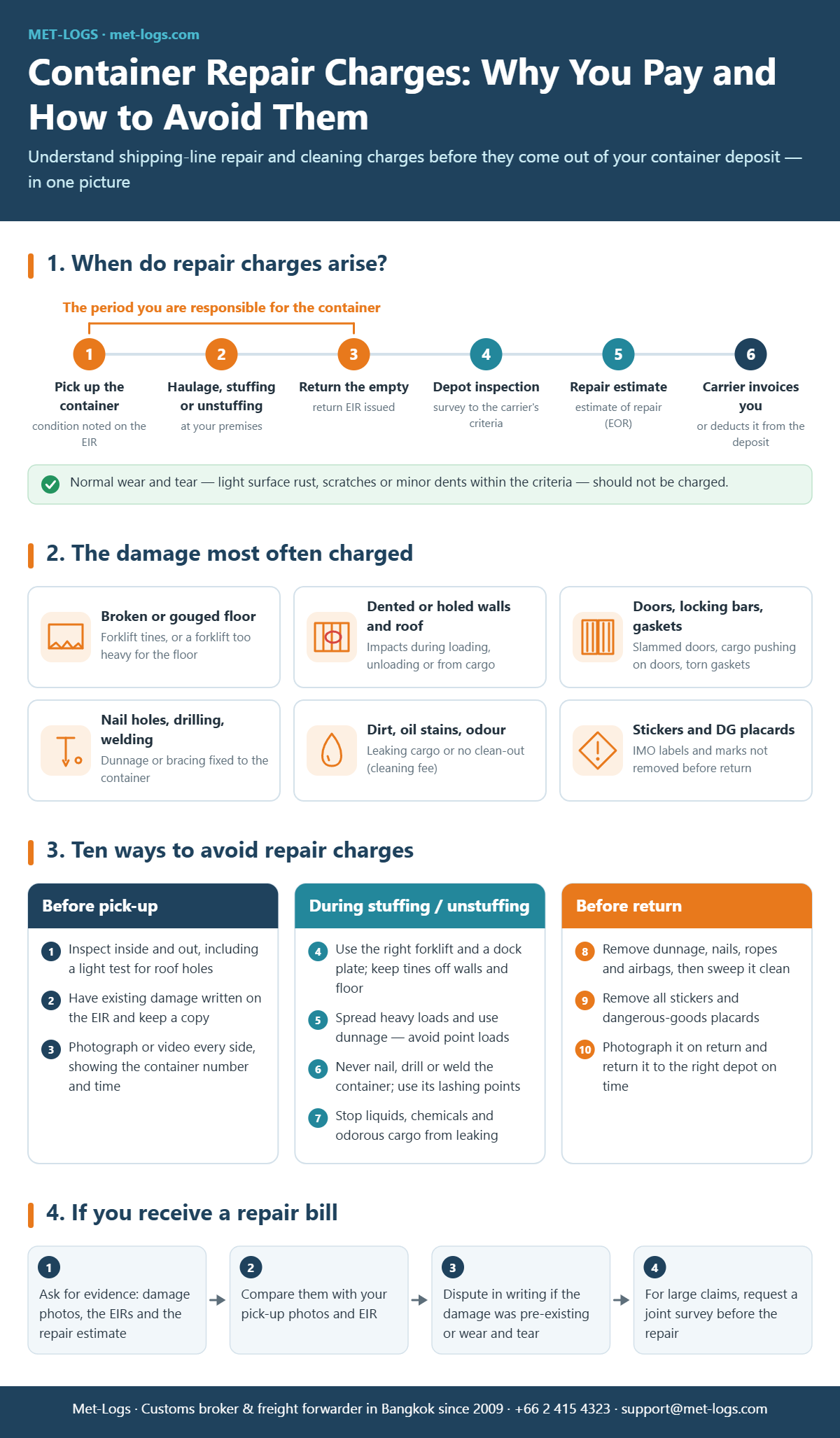
- Repair charges come from the depot’s inspection when the empty is returned; the carrier bills whoever had the container.
- You are responsible from the moment you take the container out of the terminal or depot until you return it, and the EIR records its condition at each hand-over.
- The usual culprits: forklift damage to floors, dented panels, doors and gaskets, nail holes, dirt and odour, and labels left on.
- Inspect and photograph at pick-up, load and unload with care, and clean the box before you return it.
What is a container repair charge?
When an empty container is returned, the depot inspects it against the shipping line’s criteria. If it finds damage or dirt beyond normal use, it issues an estimate of repair (EOR) listing the location and type of damage and the repair method, and the carrier charges the party that had the container. The bill covers labour and materials, and may include a cleaning fee if the box is dirty, smells, or still carries stickers.
In Thailand, many shipping lines take a container deposit when they issue the delivery order (D/O) and refund it after the empty is returned, minus any repair, cleaning or detention charges. Repair charges therefore affect both your costs and how quickly you get your deposit back.
Who is liable for container damage?
Under most carriers’ terms, the party that takes the container is responsible for damage that happens while the container is in its custody:
- Imports: from collecting the laden container at the terminal, through unstuffing at your premises, until the empty is returned to the depot.
- Exports: from collecting the empty at the depot, through stuffing, until the laden container is delivered to the terminal.
If a haulier or a contractor caused the damage, the importer or exporter normally still pays the carrier first, then claims from that contractor or its insurer under their own agreement.
Normal wear and tear — light surface rust, scratches, or minor dents within tolerance — should not be charged. Each carrier sets its own inspection criteria, usually based on industry standards such as IICL or UCIRC.
The EIR is your most important evidence
The Equipment Interchange Receipt (EIR) is issued by the terminal or depot every time a container changes hands. It records the container number, the date and time, and the condition of the box at that moment. If existing damage is not written on the EIR when you collect the container, any damage found on return is presumed to have happened while you had it.
The EIR, together with photos that show the container number and a timestamp, is your main evidence if you need to dispute a repair bill.
The damage most often charged
| Damage | Common cause | How to prevent it |
|---|---|---|
| Broken, gouged or holed floor | Forklift tines, or a forklift heavier than the floor is rated for | Use a suitable forklift and keep the tines off the floor |
| Dented or holed walls and roof | Impacts during stuffing or unstuffing; cargo falling or pressing on panels | Secure the cargo and drive the forklift carefully |
| Doors, locking bars and gaskets | Slammed doors, cargo pushing on the doors, torn gaskets | Use a door-end barrier and open and close doors properly |
| Nail holes, drilling, welding | Dunnage or bracing nailed or fixed to the container | Use lashing points, straps and airbags instead |
| Dirt, oil stains, odour | Leaking cargo, or no clean-out before return | Use leak-proof packing and clean the box before return |
| Stickers and DG placards | IMO labels and marks left on after unstuffing | Remove them all before return |
10 ways to avoid container repair charges
Before pick-up
- Inspect the container. Walk around all four sides, check the roof where you can, then look inside at the floor, walls, doors, locking bars and gaskets. For a light test, one person steps inside while another briefly closes the doors: daylight shows any holes. If an export empty is not fit for your cargo, ask for another one.
- Get existing damage on the EIR. If you find dents, holes or other damage, have the depot or terminal record it on the EIR before the container leaves, and keep a copy.
- Take photos or video. Cover every side, inside and out, showing the container number, the seal number and a timestamp. Keep the files at least until your deposit is refunded.
During stuffing and unstuffing
- Use the right forklift. Make sure the forklift is within the container floor’s rating, use a dock plate between the dock and the container, and keep the tines away from the walls and floor.
- Spread heavy loads. Distribute the weight, use dunnage or load-spreading boards to avoid point loads, and never exceed the container’s payload.
- Never nail, drill or weld the container. Secure cargo with the built-in lashing points, straps or airbags instead of nailing dunnage to the floor or walls.
- Stop leaks. Pack liquids, chemicals and strong-smelling cargo in leak-proof packaging or use a liner, and clean up any spill straight away.
Before return
- Clear and clean the container. Remove all dunnage, nails, ropes, plastic and airbags, then sweep it clean and make sure it does not smell.
- Remove every sticker and placard. Dangerous-goods (IMO) labels left on the box usually lead to a cleaning or label-removal charge.
- Photograph it on return and return it on time. Take photos before hand-over, check the return EIR, and return the empty to the depot the carrier nominated within the free time to avoid detention.
What to do if you receive a repair bill
- Ask for the evidence: photos of the damage, the EIRs for pick-up and return, and the repair estimate showing the location and damage codes.
- Compare it with your own records: check your pick-up photos and EIR to see whether the damage was already there.
- Dispute in writing: if the damage was pre-existing or is normal wear and tear, send your evidence within the carrier’s dispute deadline.
- For large claims, ask for a joint survey before the repair, and check that the proposed repair matches the actual damage.
- Claim from whoever caused it: if a haulier or contractor damaged the container, claim from them or their insurer under your agreement.
For cargo that is likely to damage containers, some carriers sell damage protection cover that caps the repair cost you pay. Check what is covered before you buy it.
Frequently asked questions
How much does a container repair cost?
It depends on the type and extent of the damage, the container type and the depot’s labour rates — from a small cleaning or label-removal fee to several hundred US dollars or more to replace floor boards or wall panels. Damage to a reefer’s refrigeration unit usually costs far more than dry-container repairs.
What is the difference between a cleaning fee and a repair charge?
A cleaning fee covers dirt, stains, odour and labels left in or on the container. A repair charge covers physical damage such as a broken floor, dented panels or damaged doors. Both can be deducted from the container deposit.
Can I dispute a charge without pick-up photos?
Yes, if the pick-up EIR records the damage. Without photos or an EIR note, a dispute is unlikely to succeed, so photograph every pick-up and every return.
When will I get my container deposit back?
After the empty has been returned and inspected. Timing varies by carrier, and any repair, cleaning or detention charges are deducted before the balance is refunded.
How Met-Logs can help
Met-Logs runs container haulage between Laem Chabang, Lat Krabang, Bangkok Port and factories around Rama II and Samut Sakhon, and handles customs clearance for imports and exports. We help check container condition, keep photo evidence at pick-up and return, and liaise with the shipping line when a repair charge needs to be disputed. Overseas forwarders with nominated cargo to or from Thailand are welcome to contact us.
Related reading: Bill of Lading Types Explained: House vs Master B/L, Original vs Surrender vs Sea Waybill
Need container haulage or customs clearance in Thailand?
Our team replies within business hours, Monday–Friday 08:30–17:30 (GMT+7).
อ่านฉบับภาษาไทย: ค่าซ่อมตู้สายเรือคืออะไร? สาเหตุที่โดนเรียกเก็บ และ 10 วิธีหลีกเลี่ยงค่าซ่อมตู้คอนเทนเนอร์