
Every ocean shipment moves on a bill of lading (B/L), yet the many names around it — House B/L, Master B/L, Original B/L, Surrender B/L, Telex Release, Sea Waybill — confuse even experienced traders. This guide explains the difference in one picture, with a comparison table and a simple rule for choosing the right release type for your payment terms.
อ่านฉบับภาษาไทย: B/L แต่ละแบบต่างกันอย่างไร?
- House B/L is issued by the forwarder to the real exporter and importer; the Master B/L is issued by the shipping line to the forwarder.
- Original B/L: an original must be surrendered at destination — use it with an L/C or D/P.
- Surrender / Telex Release: originals are surrendered at origin, so the importer collects the cargo without them — use it once the seller has been paid.
- Sea Waybill: no originals and not a document of title — use it between affiliated companies or trusted partners.
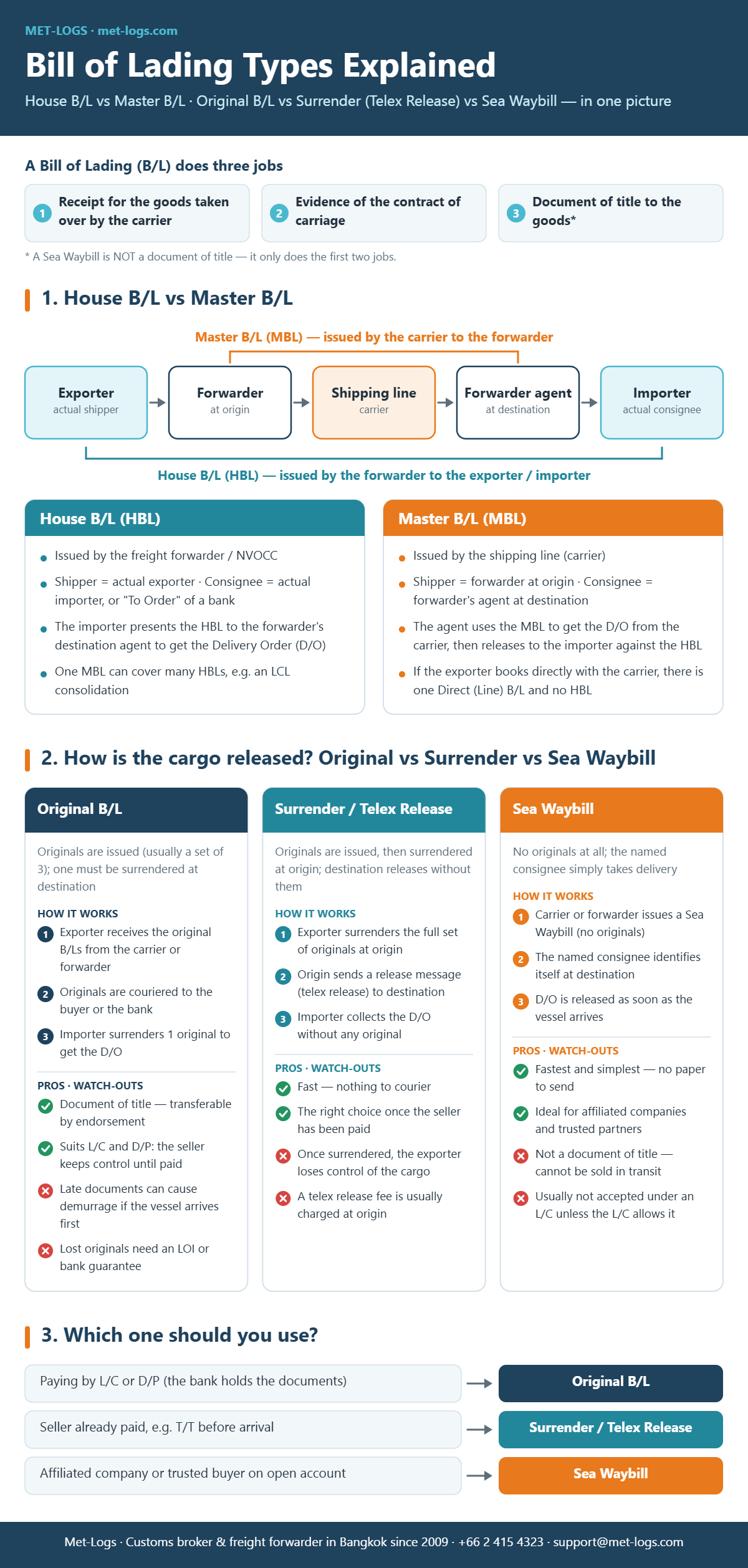
What does a bill of lading do?
A bill of lading is issued by the carrier (or by a forwarder acting as carrier) when it takes over the goods. It does three jobs:
- Receipt for the goods — it confirms what was loaded, how much, and in what apparent condition.
- Evidence of the contract of carriage — it records the terms under which the goods are carried.
- Document of title — whoever lawfully holds an original can claim the goods, and a “to order” B/L can be transferred by endorsement.
The third job is why the B/L type matters: it decides who controls the cargo and what the importer must present to get the Delivery Order (D/O) at destination.
House B/L vs Master B/L
When a freight forwarder is involved, there are two layers of bills of lading for the same cargo.
Master B/L (MBL)
The shipping line issues the Master B/L to the forwarder. The forwarder at origin is the shipper, and the forwarder’s agent at destination is the consignee. The agent uses the MBL to obtain the D/O from the carrier.
House B/L (HBL)
The forwarder (or NVOCC) issues the House B/L to the actual exporter. The exporter is the shipper, and the actual importer — or “to order” of a bank — is the consignee. The importer presents the HBL to the forwarder’s agent at destination, not to the shipping line.
Example: an LCL container carrying goods from three exporters moves on one Master B/L between the carrier and the forwarder, and three House B/Ls — one for each exporter.
If the exporter books directly with the shipping line, there is a single Direct B/L (also called a Line B/L) naming the actual shipper and consignee, and no House B/L.
| House B/L (HBL) | Master B/L (MBL) | |
|---|---|---|
| Issued by | Freight forwarder / NVOCC | Shipping line (carrier) |
| Shipper | Actual exporter | Forwarder at origin |
| Consignee | Actual importer, or “to order” | Forwarder’s agent at destination |
| D/O released by | Forwarder’s agent at destination | Shipping line |
| How many per container | Several possible (e.g. LCL) | Normally one per carrier booking |
Original B/L vs Surrender (Telex Release) vs Sea Waybill
The next question is how the importer gets the cargo at destination. There are three main options.
1. Original B/L
The carrier or forwarder issues original bills, usually a full set of three (3/3). The exporter sends them to the buyer or the bank by courier, and the importer must surrender at least one original to obtain the D/O. Once one original is accomplished, the others become void.
- Best for: letters of credit (L/C) and documents against payment (D/P), where the bank holds the documents and the seller keeps control until paid.
- Watch out for: if the originals arrive after the vessel, the cargo cannot be released and demurrage can build up. If an original is lost, the carrier will usually require a letter of indemnity, often backed by a bank guarantee.
A B/L consigned “to order” or “to order of [a bank]” is negotiable and can be transferred by endorsement, which is why it works with an L/C. A straight B/L naming a specific consignee cannot be transferred by endorsement.
2. Surrender B/L / Telex Release
Originals are issued as normal, but the exporter surrenders the full set at origin. The origin office then sends a release message — a telex release or express release — to destination. The copy B/L is stamped “SURRENDERED”, and the importer collects the D/O without any original.
- Best for: shipments where the seller has already been paid, for example by T/T before shipment or before arrival, and short routes where the vessel arrives before a courier would.
- Watch out for: once the bills are surrendered, the exporter loses control of the cargo, so never surrender before payment is received. A telex release fee is usually charged at origin.
3. Sea Waybill
A Sea Waybill is a non-negotiable transport document: no originals are ever issued and it is not a document of title. The carrier releases the cargo to the named consignee on proof of identity. Some carriers call it an “Express B/L”.
- Best for: shipments between affiliated companies, and trusted partners trading on open account.
- Watch out for: the goods cannot be sold in transit by transferring the document, and it is usually not acceptable under an L/C unless the credit specifically allows a sea waybill.
| Original B/L | Surrender / Telex Release | Sea Waybill | |
|---|---|---|---|
| Originals issued | Yes, usually 3 | Yes, but surrendered at origin | No |
| Document of title | Yes | Yes, until surrendered | No |
| Transfer by endorsement | Yes, if “to order” | No, once surrendered | No |
| Importer gets the D/O by | Surrendering 1 original | Release message from origin | Proving it is the named consignee |
| Works with an L/C | Yes | Rarely | Only if the L/C allows it |
| Speed at destination | Slowest (courier) | Fast | Fastest |
| Main risk | Late or lost documents | Surrendering before payment | Seller has no document to hold back |
Which one should you use?
- Paying by L/C or D/P → Original B/L
- Seller already paid (T/T in advance or before arrival) → Surrender / Telex Release
- Affiliated company or trusted buyer on open account → Sea Waybill
Agree the B/L type in the sales contract and tell your forwarder when you book. Changing it later can cost fees and delay the release.
Checklist before the B/L is issued
- Check the draft B/L: shipper, consignee and notify party names and addresses, cargo description, number of packages, weights, and ports must match the commercial invoice, packing list and any L/C terms.
- For imports into Thailand, the B/L numbers on the customs declaration must match the vessel’s cargo manifest. On forwarder shipments, the Master B/L and House B/L numbers must be paired correctly.
- Know who releases the D/O: the forwarder’s agent for a House B/L, the shipping line for a Direct B/L.
- If you use originals, allow time for the courier — on short routes such as China, Vietnam or Malaysia to Thailand, the vessel often arrives before the documents.
Frequently asked questions
What is an “Express B/L”?
The term is used differently by different carriers — sometimes for a Sea Waybill, sometimes for a B/L that has been surrendered. Always confirm what the importer will need to present at destination.
How long does a telex release take?
Usually the same or the next working day, once the full set of originals has been surrendered and any origin charges have been paid. Ask for the copy stamped “SURRENDERED” or the carrier’s release confirmation.
What if an original B/L is lost?
Tell the carrier or forwarder at once. The carrier will normally ask for a letter of indemnity, often countersigned by a bank, before it releases the cargo or reissues the bills. This takes time and costs money.
Can a Sea Waybill be used under an L/C?
Only if the credit specifically allows it. Most letters of credit call for a full set of clean on-board original bills of lading.
Does the importer need the House B/L or the Master B/L?
The importer uses the document issued in its own name — the House B/L on a forwarder shipment — and collects the D/O from the forwarder’s agent. The Master B/L is between the forwarder and the carrier.
Working with Met-Logs in Thailand
Met-Logs is a Bangkok-based freight forwarder and customs broker, established in 2009 and a member of the Thai International Freight Forwarders Association (TIFFA). We handle B/L documentation for imports and exports: checking draft B/Ls, arranging telex releases, collecting delivery orders and clearing customs at Laem Chabang, Bangkok Port, Lat Krabang ICD and Suvarnabhumi Airport. Overseas forwarders looking for a Thailand partner for nominated cargo are welcome to contact us.
Need help with B/Ls, telex releases or customs clearance in Thailand?
Our team replies within business hours, Monday–Saturday 08:30–17:30 (GMT+7).
อ่านฉบับภาษาไทย: B/L แต่ละแบบต่างกันอย่างไร? House B/L, Master B/L, Original B/L, Surrender และ Sea Waybill