
LCL (Less than Container Load) shipping lets businesses move small volumes by sea without paying for a whole container. You pay for the space your cargo actually uses. Even so, many importers and exporters run into two surprises: a destination bill far higher than expected, and cargo that cannot be collected even though the vessel has already arrived. This guide explains why LCL local charges differ from one forwarder to the next, how to calculate LCL costs, how to keep them under control when you agree the sales terms, and how much time to allow after arrival in Thailand.
อ่านฉบับภาษาไทย: ขนส่งแบบ LCL กับค่าใช้จ่ายที่ต้องระวัง
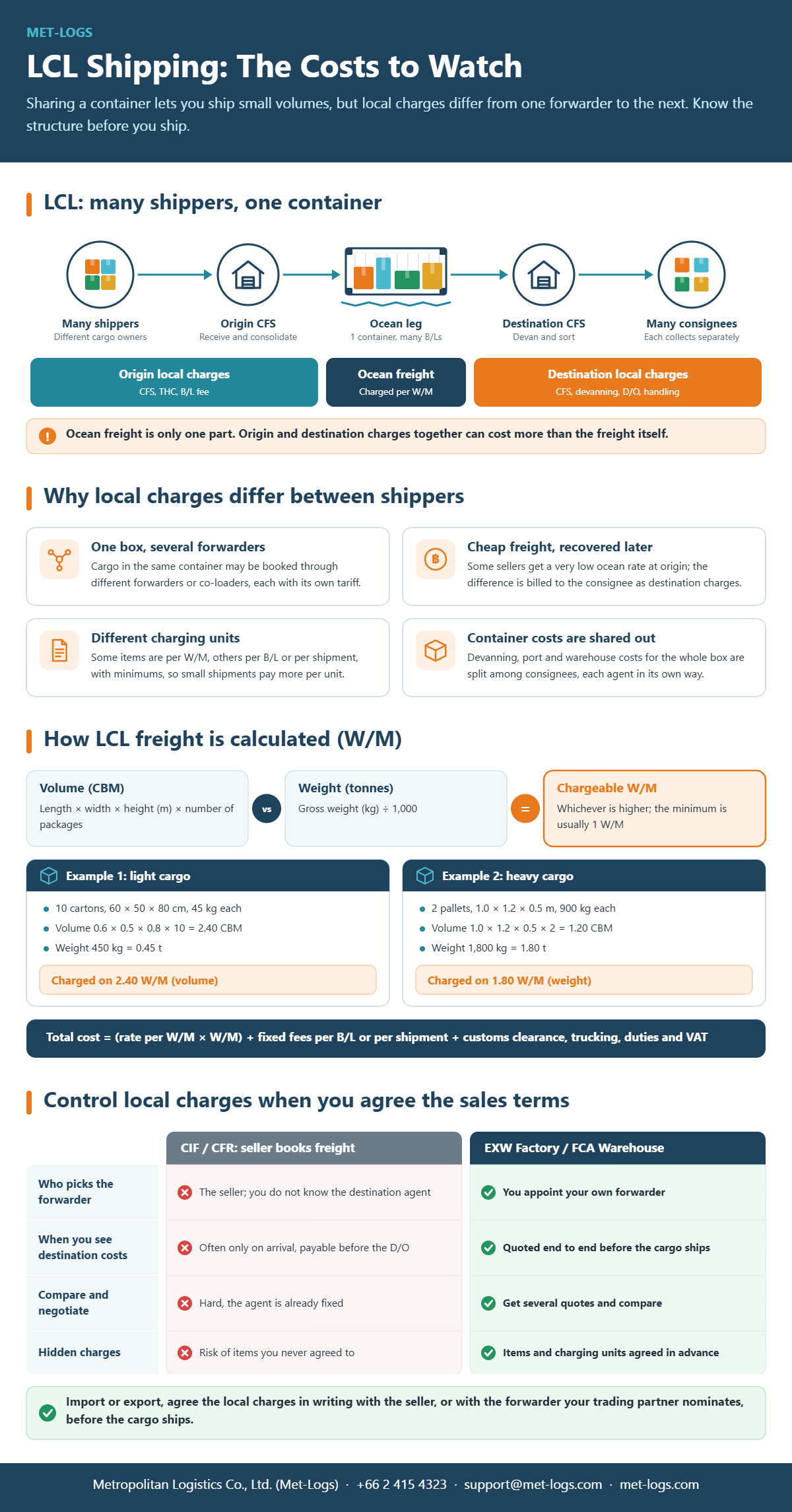
- LCL means sharing a container. Cargo from several shippers is packed into one box at the origin CFS and split out again at the destination CFS.
- Local charges are not the same for everyone in the box. Cargo in one container can come through different forwarders, with different charging units, and some recover cheap ocean freight through destination charges.
- LCL is charged by W/M. Compare volume (CBM) with weight (tonnes) and use the higher figure; the minimum is usually 1 W/M.
- Always agree local charges before the cargo ships, for exports and imports alike. Importers who buy EXW Factory or FCA Warehouse choose their own forwarder and see every cost up front.
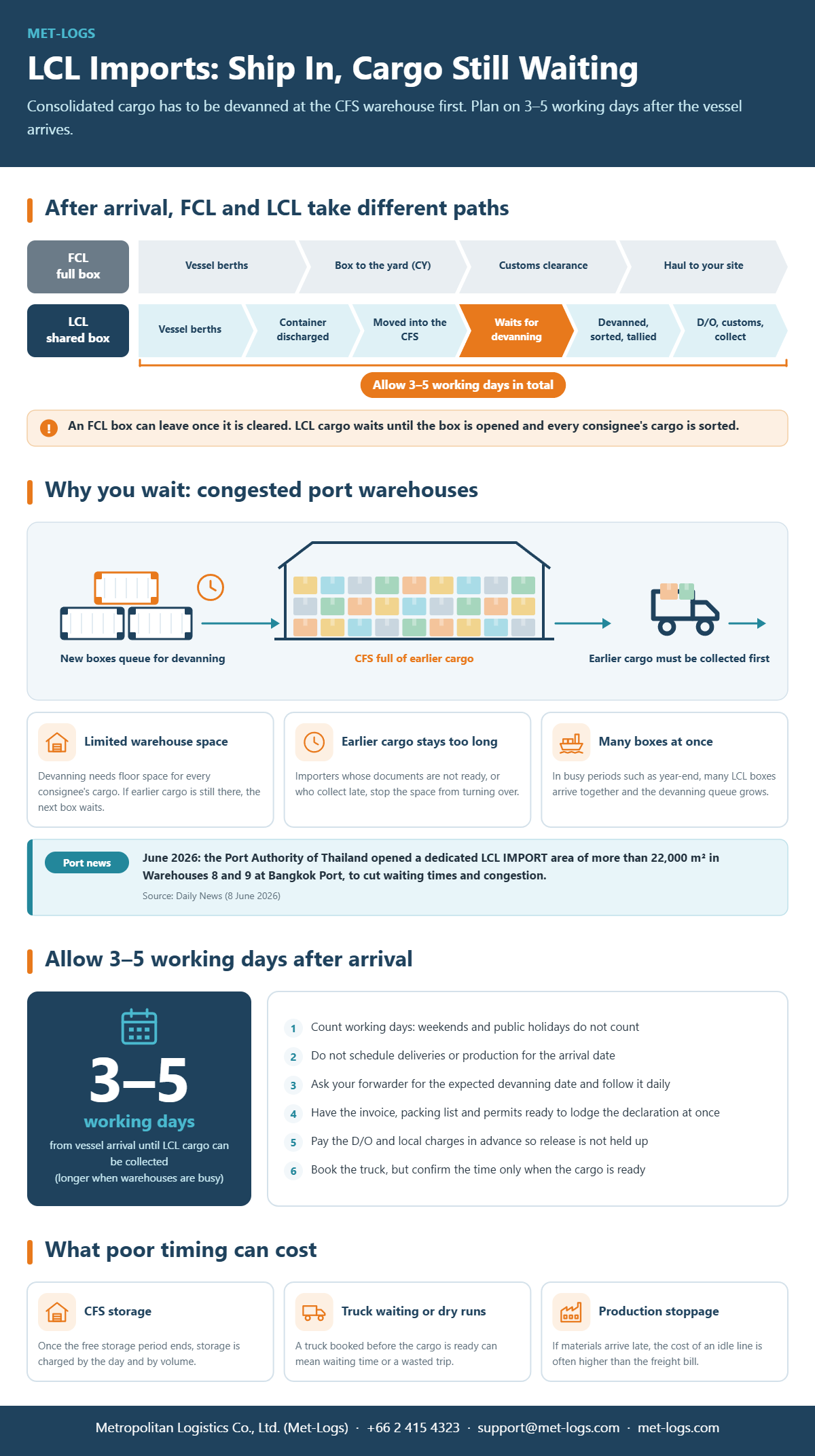
- Allow 3–5 working days after the vessel arrives for LCL imports. The box has to be devanned at a CFS warehouse that is often still full of earlier cargo.
What is LCL, and how is it different from FCL?
LCL stands for Less than Container Load. A forwarder or consolidator collects cargo from several shippers and packs it into one container (consolidation) at a container freight station (CFS) at origin. At destination the box goes into a CFS warehouse, where it is opened and each consignee’s cargo is separated (deconsolidation or devanning). With FCL (Full Container Load), one shipper uses the whole box and can haul it out of the yard as soon as customs clearance is done.
| FCL (full container) | LCL (shared container) | |
|---|---|---|
| Who uses the box | One shipper | Several shippers share it |
| Ocean freight | Per container (20′ / 40′) | Per W/M (volume or weight) |
| Handover point | Container yard (CY) or your door | CFS warehouse at both ends |
| After arrival | Hauled out once cleared | Waits to be devanned and sorted |
| Costs to watch | Terminal charges, demurrage and detention | Local charges per W/M and per B/L, CFS storage |
| Best for | Large volumes | Small volumes, trial orders, frequent small shipments |
LCL saves money on small volumes because you do not pay for the whole box. The trade-off is the extra CFS handling at both ends, which is where most of the hidden cost and waiting time comes from.
Why LCL local charges differ between shippers
Local charges are the costs incurred in the origin or destination country on top of ocean freight: CFS fees, terminal handling (THC), documentation, delivery order (D/O) fees and so on. For FCL they are fairly predictable because one shipper uses the whole box. In LCL, one container carries cargo for many owners, so what each consignee pays depends on who handled their cargo along the way.
1. One box, several forwarders
The LCL market is built around consolidators (co-loaders) who run the containers and take cargo from many forwarders. Cargo in the same box may have been booked through different companies, each with its own local-charge tariff. Two importers whose goods arrive in the same container can receive invoices with different items and totals.
2. Cheap freight at origin, recovered at destination
On intra-Asia lanes, where ocean rates are very low, some forwarders win cargo by offering the shipper a very low or even negative freight rate, then recover the difference from the consignee as destination charges. The Maritime Executive describes how this pushes much of the cost onto the destination end, particularly in Southeast Asian markets. Buyers on CIF or CFR terms see freight “included” in the price of the goods, then meet a large bill when they ask for the D/O.
3. Different charging units and minimums
Some items are charged per W/M (CFS fees, for example), others as a flat fee per B/L or per shipment (D/O, documentation, handling), and most have a minimum. A 0.5 CBM shipment pays the same flat fees as a 3 CBM one, so small shipments cost far more per unit. (See also: House B/L vs Master B/L.)
4. Container-level costs are shared out
Some costs arise for the box as a whole: moving it into the CFS, devanning, port charges and the surcharges carriers bill to consolidators. These are split among the consignees in the box, and each agent does it its own way, by volume or as a flat amount per shipment.
What LCL costs are made of
The table lists the common items. Names and charging units vary between providers, and who pays each item depends on the Incoterms you agreed.
| Stage | Item | Usually charged |
|---|---|---|
| Origin | Pick-up from the factory | Per trip |
| Origin | CFS receiving and stuffing, origin THC | Per W/M, with a minimum |
| Origin | Documentation and B/L fee | Per B/L |
| Origin | Export customs clearance | Per declaration |
| Main leg | Ocean freight plus variable surcharges such as bunker | Per W/M |
| Destination | CFS / devanning, destination THC | Per W/M, with a minimum |
| Destination | D/O fee, handling or agency fee | Per B/L or per shipment |
| Destination | Storage after the free period | Per day, by volume |
| Destination | Import clearance, duties and VAT | Per declaration and cargo value |
| Destination | Delivery from the CFS to your warehouse | Per trip |
What makes the bill bigger than expected
- Minimums: under 1 CBM still pays for 1 W/M, and many items have their own minimum.
- Flat fees per B/L: splitting cargo across several B/Ls means paying D/O and documentation fees several times.
- Currency: some items are billed in US dollars and converted at the collecting agent’s exchange rate.
- VAT on local services that was not shown in the quote.
- Special handling: non-stackable, long, heavy or dangerous cargo can attract surcharges.
- Storage once the warehouse’s free period runs out.
How to calculate LCL costs
LCL freight and many LCL charges are billed per W/M (weight or measurement), also called a revenue ton. You compare volume with weight and pay on the higher figure. For sea freight, 1 CBM is treated as equal to 1,000 kg.
- Volume (CBM): length × width × height of each package in metres (outside dimensions, including the pallet), times the number of packages.
- Weight in tonnes: gross weight in kg divided by 1,000.
- Take the higher figure as the chargeable W/M. If it is below the minimum (usually 1 W/M), the minimum applies.
- Apply the rates: W/M-based items times the W/M, plus the flat fees per B/L or per shipment.
- Add the rest: customs clearance, trucking, duties and VAT.
Worked example
10 cartons, each 60 × 50 × 80 cm and 45 kg.
- Volume = 0.6 × 0.5 × 0.8 × 10 = 2.40 CBM
- Weight = 450 kg = 0.45 t
- Volume is higher, so the cargo is charged on 2.40 W/M
Using the rates below (made-up figures to show the method only, not anyone’s actual prices), the destination charges work out like this:
| Item | Example rate | Calculation | Total (THB) |
|---|---|---|---|
| Destination CFS | THB 800 / W/M | 800 × 2.40 | 1,920 |
| Destination THC | THB 300 / W/M | 300 × 2.40 | 720 |
| D/O fee | THB 1,500 / B/L | 1,500 × 1 | 1,500 |
| Handling | THB 1,000 / shipment | 1,000 × 1 | 1,000 |
| Total (before VAT, duties, clearance and trucking) | 5,140 |
Here the flat fees (THB 2,500) are almost half the total. Shrink the cargo to 0.5 CBM and the W/M items fall to the 1 W/M minimum (THB 1,100) while the flat fees stay put: the total is THB 3,600, or about THB 7,200 per CBM, against about THB 2,140 per CBM in the first case. That is why very small LCL shipments are expensive per unit.
Heavy cargo is charged on weight
Two pallets of 1.0 × 1.2 × 0.5 m at 900 kg each measure 1.20 CBM but weigh 1.80 t, so they are charged on 1.80 W/M. For steel, machine parts or drummed liquids, work out both figures before asking for quotes.
As volumes grow, ask for a 20′ FCL price as well. At some point a full container is cheaper and avoids the CFS wait altogether; the break-even depends on the lane and current rates.
Agree local charges before the cargo ships, for exports and imports
Whatever the shipment, the rule is the same: agree the local charges in writing with the seller or your trading partner before the cargo ships. Once the goods are moving you have almost no leverage; the consignee has to pay the invoice to get the D/O and release the cargo.
Imports
On CIF or CFR terms the seller chooses the forwarder and pays the ocean freight, but destination charges in Thailand are billed to the buyer by the seller’s forwarder’s local agent. Before confirming the order, ask the seller to name the forwarder and send the list of destination charges with their charging units, and agree who pays if the actual bill is higher.
Exports
When an overseas buyer nominates the forwarder, for example on FOB or FCA sales, the Thai exporter pays origin charges such as CFS, THC and the B/L fee at that forwarder’s rates. Ask for a quote for those charges before handing over the cargo, and build them into your selling price from the start.
Questions to ask before you ship
- Is each item charged per W/M, per B/L or per shipment, and what are the minimums?
- Which currency, whose exchange rate, and is VAT included?
- Which CFS will devan the box, how many free storage days are there, and what is charged after that?
- Which charges are not in the quote but could still arise, such as customs inspection or special handling?
How EXW Factory / FCA Warehouse terms help importers control local charges
For importers, the most effective way to control local charges is to buy EXW (Ex Works) at the seller’s factory or FCA (Free Carrier) at the seller’s warehouse. You appoint the forwarder, and your forwarder arranges pick-up through its agent at origin and quotes every leg: origin, ocean freight and destination. You know the full cost before the cargo moves and can compare quotes from several forwarders.
| CIF / CFR (seller books freight) | EXW Factory / FCA Warehouse (buyer appoints forwarder) | |
|---|---|---|
| Who picks the forwarder | Seller | Buyer |
| Destination charges | Often known only on arrival, payable before the D/O | Agreed in the quote before shipping |
| Compare and negotiate | Hard, the agent is already fixed | Get several quotes and compare |
| Extra work for the buyer | Little | Arranging pick-up at origin (a forwarder can handle it) |
One caution: under EXW the buyer is responsible for export clearance in the seller’s country, which can be difficult if the buyer has no presence there. Under FCA the seller clears the goods for export and hands them over at the agreed place, so it usually works better for LCL. Name the place precisely, for example “FCA Seller’s Warehouse, Shenzhen”. (See also: Incoterms 2020: who pays what and where risk passes.)
LCL imports: the ship is in, so why is the cargo not ready?
The question LCL importers ask most is “the vessel has arrived, so why can’t I collect my goods?” With LCL, the arrival date is not the date your cargo is ready. Your goods are still inside a shared box and several steps remain:
- The vessel berths and the box is discharged. Unloading a large vessel alone can take 1–3 business days (Flexport).
- The box is moved to a CFS warehouse. Some LCL boxes discharged at Laem Chabang are also barged up to Bangkok Port to be devanned there.
- It waits in the devanning queue until the warehouse has room for the whole box’s cargo.
- It is devanned, sorted and tallied: each consignee’s cargo is separated by its marks and checked against the documents.
- D/O, customs declaration and duty payment. The D/O is released once the destination charges are paid.
- The cargo is collected by the importer’s truck or the forwarder’s.
An FCL box skips steps 2–4: once it is in the yard and cleared, it can be hauled out.
The main cause: congested port warehouses
Devanning an LCL box needs enough floor space for every consignee’s cargo in it. If the warehouse is still full of cargo from earlier boxes that importers have not collected, because documents are not ready, a permit is pending or a truck has not been booked, the next box has to wait until that space is cleared. In busy periods such as year-end or before holidays, the queue grows further.
Port authorities take the problem seriously. In June 2026 the Port Authority of Thailand opened a dedicated LCL IMPORT area for coastal barge cargo in Warehouses 8 and 9 at Bangkok Port, more than 22,000 m² in total, with the stated aims of cutting waiting times for users and congestion in the port (Daily News). It happens elsewhere too: GoFreight describes an LCL shipment quoted as available 2–3 days after arrival that actually took 8 days, because the box was queued behind about 40 others at a CFS working at full capacity.
Allow at least 3–5 working days after arrival
In Met-Logs’ experience, importers should plan to collect LCL cargo about 3–5 working days after the vessel arrives in normal conditions, and allow more when warehouses are busy. To keep things on track:
- Count working days. If the vessel arrives on a Thursday, a Friday or before a long holiday, the cargo may only be ready the following week.
- Do not schedule deliveries or production for the arrival date. Plan from the date the cargo is actually ready.
- Ask for the expected devanning date and follow it until the cargo is available.
- Use the wait to prepare documents: invoice, packing list, B/L and any import permits, so the declaration can go in at once.
- Pay the D/O and local charges in advance so document release does not become another bottleneck.
- Check the free storage period and collect before storage charges start.
FAQ
What is LCL shipping?
Shipping cargo that does not fill a container. A consolidator packs goods from several shippers into one box and charges each by the volume or weight of its cargo.
How is LCL freight calculated?
By W/M: compare volume in CBM with weight in tonnes (1 CBM = 1,000 kg) and charge on the higher figure, usually with a 1 W/M minimum, then add the flat fees per B/L or per shipment.
What are local charges?
Costs in the origin or destination country that are not part of the ocean freight, such as CFS fees, THC, documentation, D/O and handling fees.
Why are LCL destination charges higher than expected?
Flat fees per B/L, minimums per item, container costs shared among consignees and, on some lanes, freight discounts recovered at destination. Get the destination charges in writing before the cargo ships.
How long after arrival can I collect LCL cargo in Thailand?
Allow about 3–5 working days in normal conditions, longer when CFS warehouses are congested, because the box must be moved into the warehouse, devanned and sorted first.
When should I switch from LCL to FCL?
When the total LCL cost approaches the price of a 20′ container, or when you need firm timing and want to avoid the CFS wait. Ask for both prices and compare.
Is buying EXW or FCA better than CIF?
If you want to control local charges and choose your own forwarder, EXW or FCA is more transparent. You take on the transport from origin, so use a forwarder with agents in the seller’s country.
Sources
- Daily News, Bangkok Port opens dedicated LCL IMPORT area of over 22,000 m² (8 June 2026, in Thai): dailynews.co.th
- GoFreight, CFS (Container Freight Station): What It Is and How It Works: gofreight.com
- Flexport Help Center, Pick up container from destination: flexport.com
- The Maritime Executive, The Hidden World of the LCL Consolidation Market, Part 1 (10 August 2020): maritime-executive.com
Working with Met-Logs in Thailand
Met-Logs is a Bangkok-based freight forwarder and customs broker, established in 2009 and a member of the Thai International Freight Forwarders Association (TIFFA). We handle LCL and FCL sea freight in both directions, arrange pick-up at origin through our worldwide agent network for EXW / FCA imports, and have customs specialists in the office. Send us the cargo details, dimensions, weight, origin and sales terms, and we will quote origin, freight and destination charges line by line before anything ships. See Sea Freight and Customs Clearance.
Want to know your full LCL cost before you ship?
Our team replies within business hours, Monday–Friday 08:30–17:30 (GMT+7).
The rates in the worked example are made up to show the method; they are not actual prices. Waiting times depend on port and warehouse conditions at the time. This article is general information.
อ่านฉบับภาษาไทย: ขนส่งแบบ LCL กับค่าใช้จ่ายที่ต้องระวัง: Local Charge วิธีคำนวณ และเวลารอตู้เปิด