
FOB, CIF and EXW turn up on almost every international quotation, but they are often written as three letters with no place attached. Then the buyer and seller each assume something different about who pays for the truck, who pays the terminal charges and who carries the loss if the cargo is damaged on the way. This guide explains all 11 Incoterms® 2020 rules in plain language, with examples from real exports and imports through Thailand.
อ่านฉบับภาษาไทย: Incoterms® 2020 คืออะไร?
- Incoterms® 2020 are rules published by the International Chamber of Commerce (ICC). They define where the seller delivers, who pays which costs and who handles customs clearance.
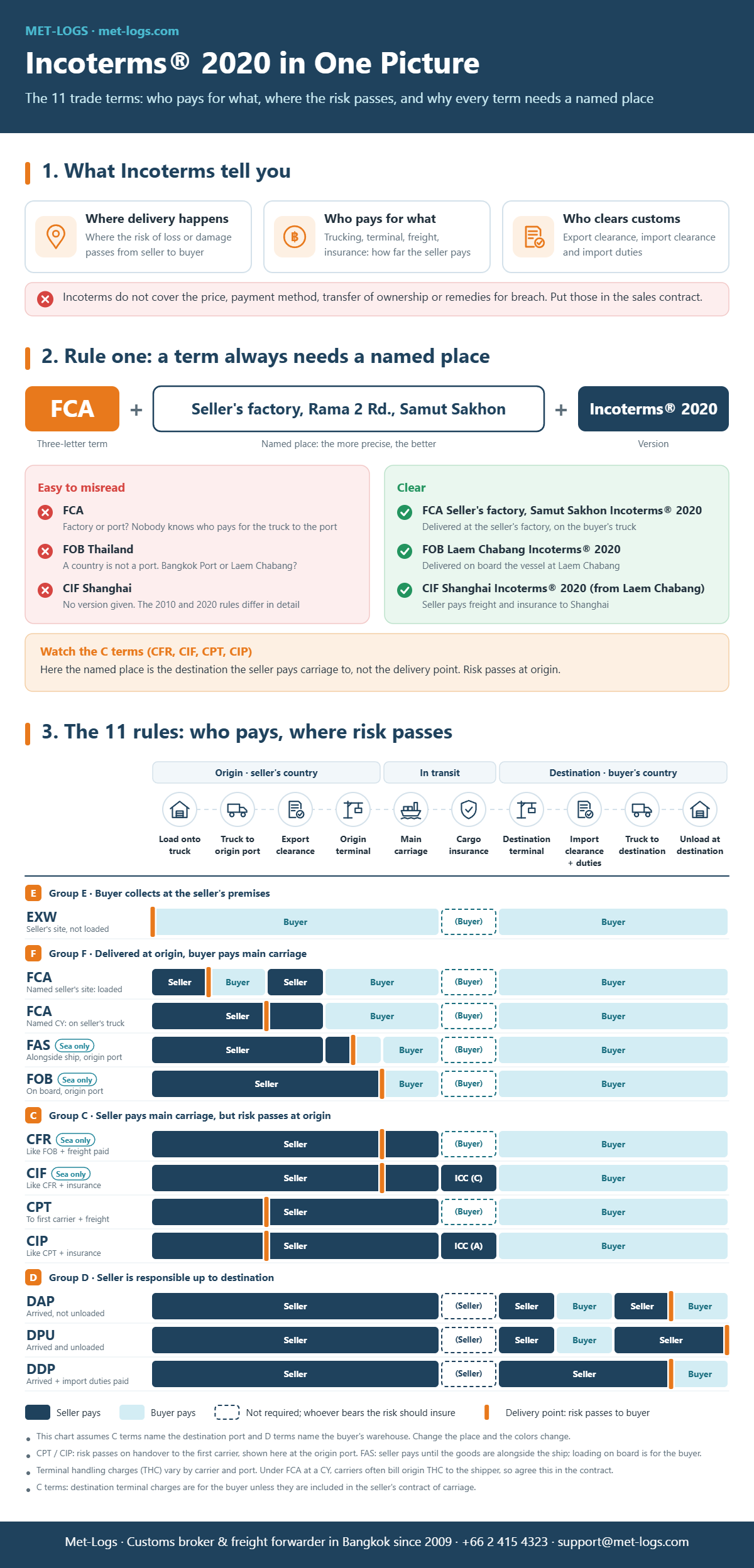
- Every term needs a named place, for example FCA Seller’s factory, Rama 2 Rd., Samut Sakhon Incoterms® 2020. Change the place and the responsibilities change with it.
- FCA does not always end at the port. If the named place is the seller’s factory, risk passes to the buyer as soon as the goods are loaded on the buyer’s truck at the factory.
- C terms (CFR, CIF, CPT, CIP): the seller pays carriage to destination, but risk passes to the buyer at origin.
- Shipping in containers? Use FCA, CPT or CIP rather than FOB, CFR or CIF.
What are Incoterms?
Incoterms (International Commercial Terms) are a set of rules from the International Chamber of Commerce (ICC) that give buyers and sellers around the world a shared language for delivery. The current edition is Incoterms® 2020, in force since 1 January 2020.
Incoterms answer three questions:
- Where does delivery happen? The delivery point is where the risk of loss or damage passes from seller to buyer.
- Who pays for what? Trucking, terminal charges, ocean or air freight and insurance: how far the seller pays and where the buyer takes over.
- Who clears customs? Who files the export declaration, who files the import declaration and who pays import duties and taxes.
Incoterms do not cover the price, the payment method (T/T, L/C, D/P), transfer of ownership or remedies for breach. Those belong in the sales contract. Incoterms only apply when the parties write them into the contract, quotation or proforma invoice.
Rule one: a term always needs a named place
The correct format is [term] + [named place] + Incoterms® 2020. The more precise the place, the better, because the place decides where each party’s costs and risk end.
| Written as | Problem | Write it as |
|---|---|---|
| FCA | Factory or port? Nobody knows who pays for the truck to the port. | FCA Seller’s factory, Rama 2 Rd., Samut Sakhon Incoterms® 2020 |
| FOB Thailand | A country is not a port. Bangkok Port or Laem Chabang? | FOB Laem Chabang Incoterms® 2020 |
| CIF Shanghai | No version given (the 2010 and 2020 rules differ in detail) and no port of shipment. | CIF Shanghai Incoterms® 2020, shipment from Laem Chabang |
Watch the C terms. For E, F and D terms, the named place is the delivery point. For C terms (CFR, CIF, CPT, CIP), the named place is the destination the seller pays carriage to, while delivery happens at origin. Name the port or place of shipment in the contract as well.
The 11 Incoterms® 2020 rules in four groups
Seven rules work for any mode of transport (sea, air, road, rail or a combination). Four are for sea and inland waterway only: FAS, FOB, CFR and CIF.
| Rule | Full name | Mode | Delivery point (risk passes) | Seller pays up to |
|---|---|---|---|---|
| EXW | Ex Works | Any | Seller’s premises, not loaded | Goods made ready only |
| FCA | Free Carrier | Any | Seller’s premises: loaded on the buyer’s vehicle / any other place: on the seller’s vehicle, ready for unloading | Delivery point + export clearance |
| FAS | Free Alongside Ship | Sea | Alongside the vessel at the port of shipment | Alongside + export clearance |
| FOB | Free On Board | Sea | On board the vessel at the port of shipment | On board + export clearance |
| CFR | Cost and Freight | Sea | On board the vessel at the port of shipment | Freight to the destination port |
| CIF | Cost, Insurance and Freight | Sea | On board the vessel at the port of shipment | Freight + minimum ICC (C) insurance to the destination port |
| CPT | Carriage Paid To | Any | Handed to the first carrier | Carriage to the named destination |
| CIP | Carriage and Insurance Paid To | Any | Handed to the first carrier | Carriage + minimum ICC (A) insurance to destination |
| DAP | Delivered at Place | Any | Named destination, on the arriving vehicle, ready for unloading | Destination, excluding import clearance and duties |
| DPU | Delivered at Place Unloaded | Any | Named destination, unloaded | Destination + unloading |
| DDP | Delivered Duty Paid | Any | Named destination, ready for unloading | Destination + import clearance, duties and taxes |
Group E: the buyer collects at the seller’s premises
EXW puts the least on the seller: make the goods ready at the factory or warehouse. The buyer loads, arranges transport and handles export clearance in the seller’s country, which makes EXW a better fit for domestic trade than for exports.
Group F: delivered at origin, the buyer pays the main carriage
Under FCA the seller hands the goods to the buyer’s carrier at the named place and always clears them for export. Under FAS the seller places the goods alongside the ship, and under FOB on board the vessel the buyer has booked. In this group the buyer pays the freight and chooses the shipping line or forwarder.
Group C: the seller pays the main carriage, but risk passes at origin
CFR and CIF are for sea freight; CPT and CIP work for any mode. The seller books and pays carriage to destination, yet risk passes to the buyer once the goods are on board (CFR, CIF) or handed to the first carrier (CPT, CIP). Under CIF and CIP the seller must also buy cargo insurance.
Group D: the seller is responsible up to destination
Under DAP the seller delivers to the named destination and the buyer unloads. DPU is the only rule where the seller must unload at destination. DDP puts the most on the seller, including import clearance, duties and import VAT in the buyer’s country. Under all three, the risk in transit is entirely the seller’s.
Example 1: FCA does not always end at the port
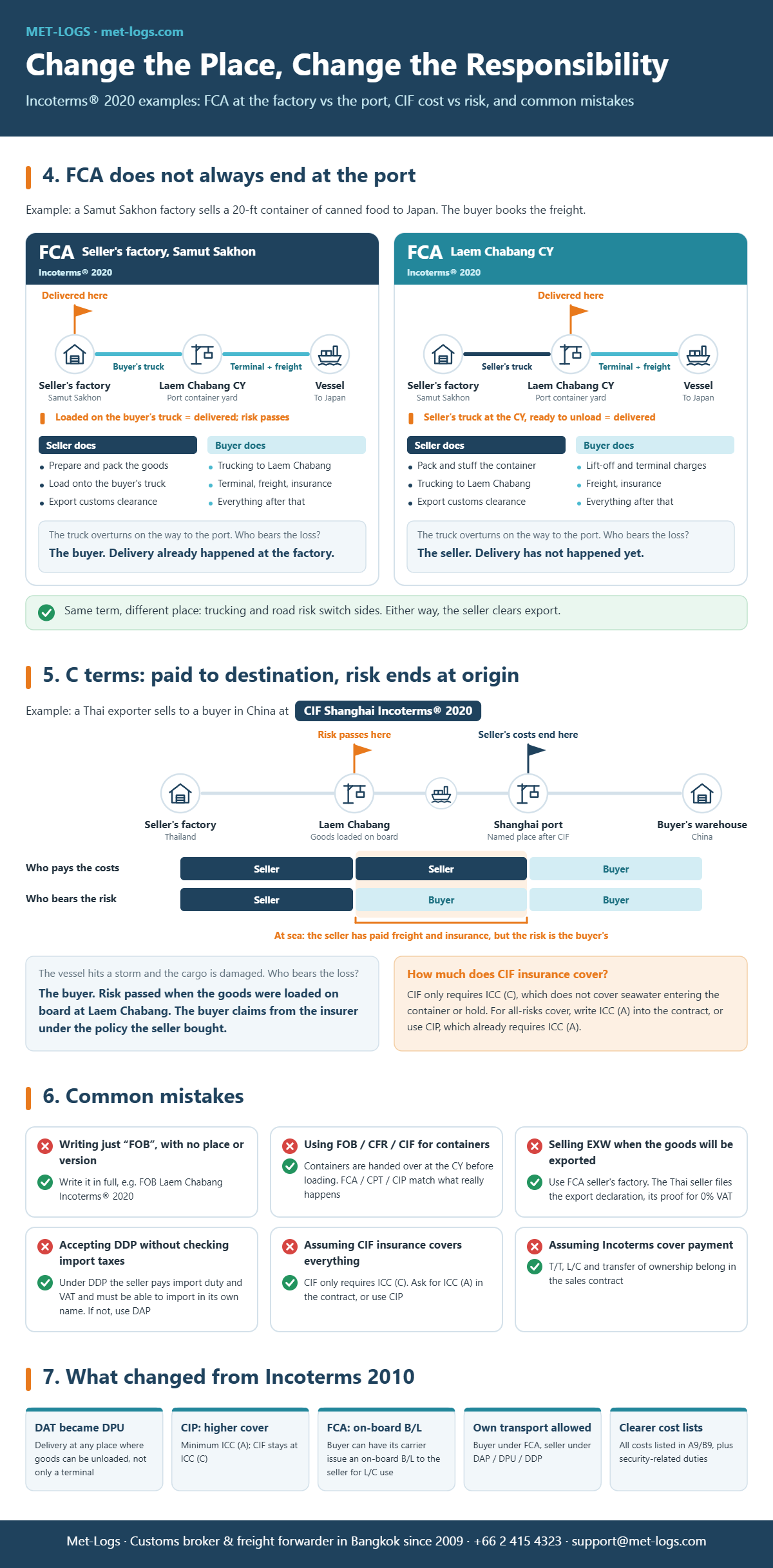
A factory in Samut Sakhon sells one 20-ft container of canned food to a buyer in Japan on FCA terms, and the buyer chooses its own forwarder. Here is how the named place changes the outcome.
| FCA Seller’s factory, Samut Sakhon | FCA Laem Chabang CY | |
|---|---|---|
| Delivered when | The container is loaded on the truck the buyer sends | The seller’s truck arrives at the CY, ready for unloading |
| Trucking to Laem Chabang | Buyer | Seller |
| Lift-off and origin terminal charges | Buyer | Buyer (agree this explicitly in practice) |
| Export clearance | Seller | Seller |
| The truck overturns on the way to the port. Who bears the loss? | The buyer: delivery already happened at the factory | The seller: delivery has not happened yet |
Same term, different place, and the trucking cost and road risk switch sides. Writing just “FCA” or “FCA Thailand” leaves room for a dispute over both the cost and the insurance claim.
Example 2: CIF is paid to destination, but risk ends at origin
A Thai exporter sells to a buyer in China on CIF Shanghai Incoterms® 2020. The seller pays freight and insurance all the way to Shanghai, but risk passes to the buyer once the goods are loaded on board at Laem Chabang.
If the vessel hits a storm and the cargo is damaged, the loss is the buyer’s. The buyer claims from the insurer under the policy the seller bought. CIF only requires ICC (C), which covers a short list of major perils such as stranding, sinking, collision and fire, but not seawater entering the container or hold. If storm water gets into the container, the buyer may have no claim at all. For all-risks cover, write ICC (A) into the contract, or use CIP, which already requires ICC (A). Under both CIF and CIP the cover must be at least 110% of the contract price.
Example 3: importing into Thailand on FOB, DAP or DDP
An importer in Samut Sakhon buys machinery from China.
- FOB Ningbo: the importer books the freight through its forwarder and controls the cost and schedule. It pays freight, insurance, Thai terminal charges, import clearance and duties.
- DAP buyer’s warehouse, Samut Sakhon: the seller delivers to the door, but the importer still clears customs and pays import duty and VAT. A customs broker still needs to coordinate with the seller’s forwarder.
- DDP buyer’s warehouse, Samut Sakhon: the seller must act as the importer in Thailand, which most foreign sellers cannot do directly. Before agreeing to DDP, ask who will be the importer on the customs declaration.
Thai Customs calculates import duty on the CIF value. Even when you buy EXW, FCA or FOB, the freight and insurance to Thailand must be declared and added to the customs value.
Common mistakes
- Writing just “FOB”, with no place or version. Write it in full, e.g. FOB Laem Chabang Incoterms® 2020.
- Using FOB, CFR or CIF for containers. Containers are usually handed over at the CY days before loading. The seller has lost control of the box but still carries the risk. The ICC recommends FCA, CPT or CIP instead.
- Selling EXW when the goods will be exported. A Thai seller may end up without an export declaration in its own name to support 0% VAT. Use FCA seller’s factory instead and check the tax treatment with your accountant.
- Accepting DDP without checking import taxes. The seller pays import duty and VAT in the buyer’s country and must be able to import in its own name. If not, use DAP.
- Assuming CIF insurance covers everything. CIF only requires ICC (C). Agree on more if you need it.
- Assuming Incoterms cover payment. Payment terms and transfer of ownership belong in the sales contract.
What changed from Incoterms 2010
- DAT became DPU. Delivery can be at any place where the goods can be unloaded, not only a terminal.
- CIP: higher cover. The minimum is now ICC (A); CIF stays at ICC (C).
- FCA: on-board B/L. The buyer can instruct its carrier to issue an on-board bill of lading to the seller for use under an L/C.
- Own transport allowed. The buyer under FCA, and the seller under DAP, DPU and DDP, may use their own vehicles instead of a third-party carrier.
- Clearer cost lists. Each party’s costs are listed together in A9/B9, and security-related duties are allocated explicitly.
Which rule should you use?
| Situation | Suitable rules | Why |
|---|---|---|
| Exporter wants the least responsibility | FCA seller’s factory | Close to EXW, but the seller still files the export declaration |
| Container (FCL/LCL) or air shipments | FCA, CPT, CIP | Matches where delivery really happens: CY, CFS or airport warehouse |
| Bulk cargo by sea, e.g. rice, sugar, ore | FOB, CFR, CIF | Goods are delivered at the vessel itself |
| Importer wants to control freight and pick its own forwarder | FCA or FOB | The buyer books the freight and sees the real transport cost |
| Buyer wants a delivered-to-door price | DAP or DPU | The seller arranges transport to destination; the buyer handles import clearance and duties |
| Payment by L/C that requires an on-board B/L | FOB, CFR, CIF, or FCA with the on-board B/L option | Banks usually want a B/L confirming the goods are on board |
Frequently asked questions
Can we still use Incoterms 2010?
Yes, if both parties agree and write “Incoterms 2010” in the contract. The ICC has not withdrawn earlier editions, but it recommends the latest one. Whatever you choose, always state the version.
What is the difference between FOB and FCA?
FOB delivers when the goods are on board the vessel and is for sea freight only. FCA delivers to the carrier at a named place, such as the seller’s factory, a CY or an airport warehouse, and works for any mode. For containers, FCA reflects reality better, because the seller hands the container over at the CY before it is loaded.
Who pays origin THC?
Under FOB, the seller pays until the goods are on board. Under FCA it depends on the delivery point. In practice, carriers bill these charges differently, so state on the quotation who pays origin and destination THC.
Can Incoterms be used for domestic sales?
Yes. Incoterms® 2020 are designed for both domestic and international trade. The customs clearance obligations only apply where goods are exported or imported.
How much insurance do CIF and CIP require?
At least 110% of the contract price, in the currency of the contract. The minimum is ICC (C) for CIF and ICC (A) for CIP.
Working with Met-Logs in Thailand
Met-Logs is a Bangkok-based freight forwarder and customs broker, established in 2009 and a member of the Thai International Freight Forwarders Association (TIFFA). We can review the Incoterms on your quotation, estimate the landed cost to your warehouse, book freight on FCA or FOB terms, and clear customs at Laem Chabang, Bangkok Port, Lat Krabang ICD and Suvarnabhumi Airport.
Need help with Incoterms, freight or customs clearance in Thailand?
Our team replies within business hours, Monday–Friday 08:30–17:30 (GMT+7).
Incoterms® is a registered trademark of the International Chamber of Commerce (ICC). This article is a plain-language summary, not the official ICC text.
อ่านฉบับภาษาไทย: Incoterms® 2020 คืออะไร? สรุป 11 เทอม ใครจ่ายอะไร ความเสี่ยงโอนตรงไหน พร้อมตัวอย่าง