
Every import or export shipment travels with two documents from the seller: the commercial invoice and the packing list. Between them they supply almost all the data that ends up on the bill of lading, the certificate of origin and the customs declaration, so a mismatch between the two repeats on every document after them. This guide explains what each document is, what it must show and how they differ, walks through a worked example, and lists what has to match before a Thai import declaration is filed.
อ่านฉบับภาษาไทย: Invoice กับ Packing List คืออะไร?
The 30-second version
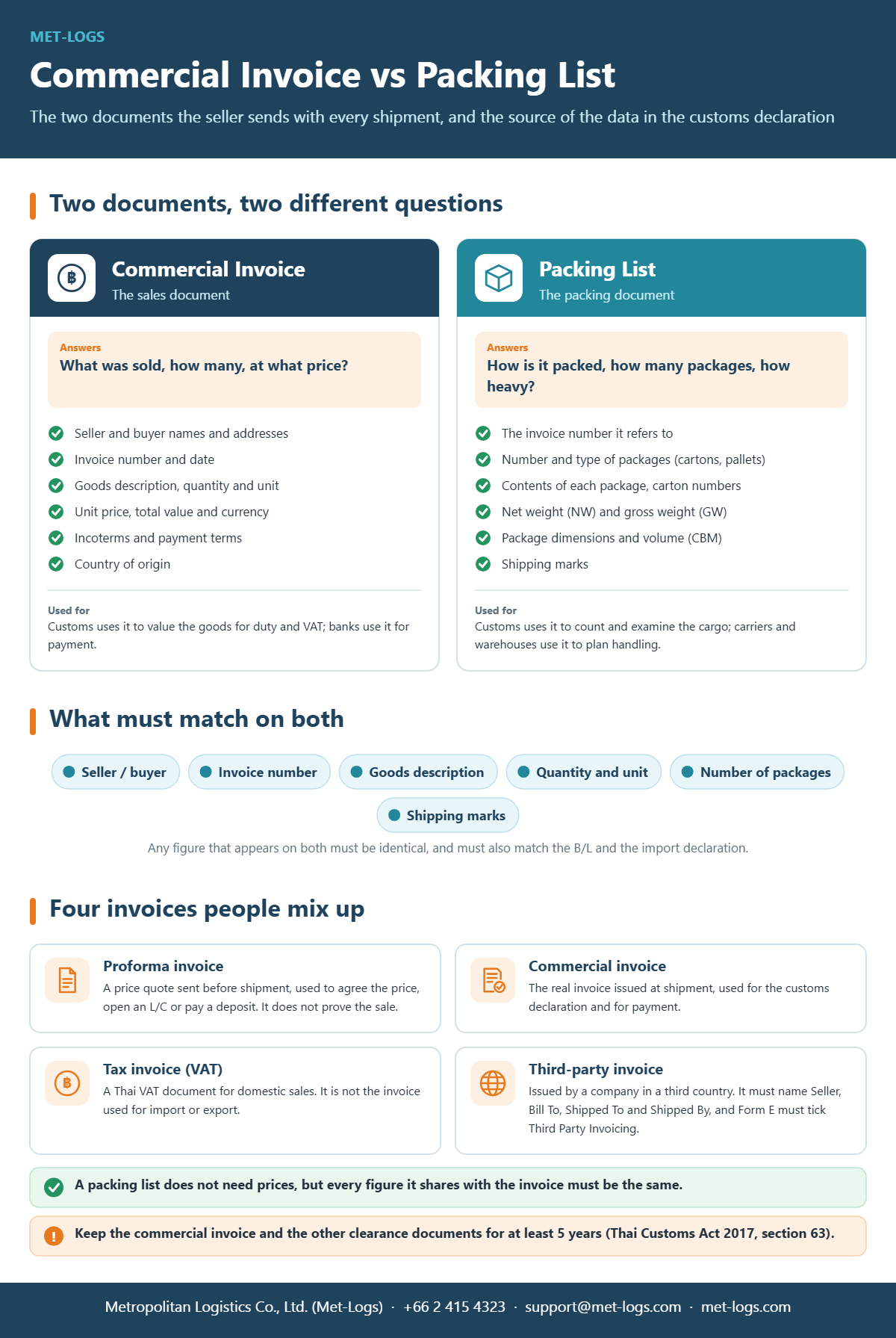
- The commercial invoice says what was sold and for how much. Thai Customs starts from the invoice price when it values the goods for import duty and VAT.
- The packing list says how the goods are packed and how heavy they are: number of packages, contents of each package, weights and dimensions. It does not need prices.
- Figures that appear on both must be identical. Quantity, number of packages, weights and shipping marks must agree across the invoice, packing list, B/L and declaration.
- A proforma invoice or a VAT tax invoice is not a commercial invoice. The declaration is based on the commercial invoice issued at shipment.
- Eight fields must match character for character: seller and buyer names and addresses, invoice number and date, Form E number and issue date.
- A third-party invoice must name all four parties: Seller, Bill To (Sold To), Shipped To (CNEE) and Shipped By (Shipper).
- Keep the commercial invoice for at least 5 years from the date the declaration is filed, under the Thai Customs Act.
What is a commercial invoice?
The commercial invoice is the seller’s bill for the goods, issued at shipment. It states what was sold, how many, at what price and on what terms. Thai Customs lists the invoice (บัญชีราคาสินค้า) first among the documents an importer should prepare to support the import declaration, and the invoice price is the starting point for the customs value on which import duty and VAT are calculated.
What a commercial invoice must show
| Information | Why it matters |
|---|---|
| Seller (shipper) and buyer (consignee) names and addresses | Must match the B/L, Form E and declaration character for character |
| Invoice number and date | Referenced by the declaration and by Form E (box 10) |
| Description of goods | Detailed enough to classify and examine the goods: product name, material, size, model. “Parts” or “Accessories” is not enough |
| Quantity, unit, unit price and line value | Quantity × unit price must equal the line value, and the lines must add up to the invoice total |
| Currency and total value | Converted to Thai baht to calculate duty and tax |
| Incoterms and named place, e.g. FOB Ningbo | Shows how far the price covers transport. Thai Customs assesses duty on a CIF basis, so FOB or EXW prices need freight and insurance added on the declaration (see Incoterms 2020 explained) |
| Payment terms, e.g. T/T, L/C | Under an L/C, the goods description on the invoice must correspond with the credit |
| Country of origin | Needed for FTA preference and must be consistent with Form E |
| Shipping marks and number of packages (if shown) | Must match the packing list and B/L |
| For third-party invoicing: Seller, Bill To (Sold To), Shipped To (CNEE) and Shipped By (Shipper) | All four must be shown so the invoicing seller can be tied to the exporter on the B/L and Form E (see below) |
What is a packing list?
The packing list is issued by the seller or exporter alongside the invoice. It describes the physical shipment: what kind of packages, how many, what is in each, how much they weigh and how big they are. It does not need prices. When a Thai declaration is selected for examination (red line), the officer checks the goods against the declaration data, and the packing list lets them find and count the right cartons quickly. Carriers, terminals and warehouses use it to plan handling and to charge by weight or volume.
What a packing list must show
| Information | Why it matters |
|---|---|
| The invoice number and date it refers to | Ties the packing list to the right invoice |
| Number and type of packages, e.g. 100 CTNS, 4 PALLETS | Must match the B/L and the number of packages on the declaration |
| Carton numbers and contents of each package, e.g. C/NO. 1-50, 24 pieces per carton | Lets the officer find the goods straight away during an examination |
| Net weight (NW) | Weight of the goods without packing; entered on the declaration and important for goods with duty charged by weight |
| Gross weight (GW) | Weight including packing; must match the B/L |
| Package dimensions and volume (CBM) | Used for LCL freight and container planning (see LCL shipping costs in Thailand) |
| Shipping marks | Must match the marks on the cartons, the B/L and Form E (box 6) |
Commercial invoice vs packing list: the differences
| Topic | Commercial invoice | Packing list |
|---|---|---|
| Thai Customs name | บัญชีราคาสินค้า | บัญชีรายละเอียดบรรจุหีบห่อ |
| Answers | What was sold, how many, at what price? | How is it packed, how many packages, how heavy? |
| Prices | Required | Not needed |
| Weights and dimensions | Sometimes a total weight | NW, GW and dimensions in full |
| Main users | Customs (valuation), banks (payment), buyer (accounting) | Customs (examination), carriers, terminals, warehouses |
| If it is wrong | Duty and VAT are off, FTA preference and L/C payment are at risk | Examination problems, weight differs from the B/L, weight- or volume-based charges are wrong |
Can the invoice and packing list be one document?
Many sellers issue a single “Invoice & Packing List”, and we see them often on Thai imports. What matters is that both halves are complete: prices as well as packages, weights and dimensions. If payment is by letter of credit, issue the documents the L/C calls for. If it asks for a separate invoice and packing list, issue them separately.
Proforma invoice, commercial invoice and tax invoice
“Invoice” covers several different documents that are often confused.
| Document | Issued when / by whom | Used for |
|---|---|---|
| Proforma invoice | By the seller, before shipment | Quoting and confirming the order, opening an L/C or paying a deposit. It does not evidence the actual sale used for the declaration |
| Commercial invoice | By the seller, at shipment | The customs declaration, payment and FTA claims |
| Third-party invoice | By a company in a third country, e.g. a Hong Kong trading company invoicing goods shipped from China | Acceptable, but the invoice must name Seller, Bill To (Sold To), Shipped To (CNEE) and Shipped By (Shipper), and for Form E the Third Party Invoicing box (box 13) must be ticked and the invoicing company’s name and country shown in box 7 |
| Tax invoice (VAT) | By a Thai VAT-registered business, for domestic sales and services | Output and input VAT records; not an import or export document. Import VAT is evidenced by the Thai Customs receipt |
Worked example
An invented example: a Bangkok importer buys two stainless-steel kitchen products from a supplier in China on FOB Ningbo terms, by sea, invoice number INV-2611-07. Here is how the same data appears on both documents (all names and figures are illustrative).
Commercial invoice (example)
| No. | Description | Quantity | Unit Price (USD) | Amount (USD) |
|---|---|---|---|---|
| 1 | Stainless steel vacuum bottle 500 ml | 1,200 PCS | 2.50 | 3,000.00 |
| 2 | Stainless steel lunch box 1,000 ml | 600 PCS | 3.80 | 2,280.00 |
| Total | 1,800 PCS | 5,280.00 |
Footer of the invoice: Incoterms FOB Ningbo · Payment T/T · Country of origin China · Shipping marks MET / BKK / C/NO. 1-100 · 100 CTNS
Packing list (example)
| C/NO. | Description | Qty/CTN | CTNS | Total Qty | NW (KG) | GW (KG) | Measurement |
|---|---|---|---|---|---|---|---|
| 1-50 | Stainless steel vacuum bottle 500 ml | 24 PCS | 50 | 1,200 PCS | 360.00 | 425.00 | 45×35×30 cm, 2.36 CBM |
| 51-100 | Stainless steel lunch box 1,000 ml | 12 PCS | 50 | 600 PCS | 300.00 | 350.00 | 50×40×25 cm, 2.50 CBM |
| Total | 100 | 1,800 PCS | 660.00 | 775.00 | 4.86 CBM |
What must match here: invoice number INV-2611-07, quantity 1,800 PCS, 100 CTNS and the shipping marks must be the same on both documents, and the gross weight 775 KG and 100 CTNS must be the figures on the B/L. Because the price is FOB, ocean freight and insurance are added to reach the CIF value before duty is calculated.
What must match the B/L, Form E and the declaration
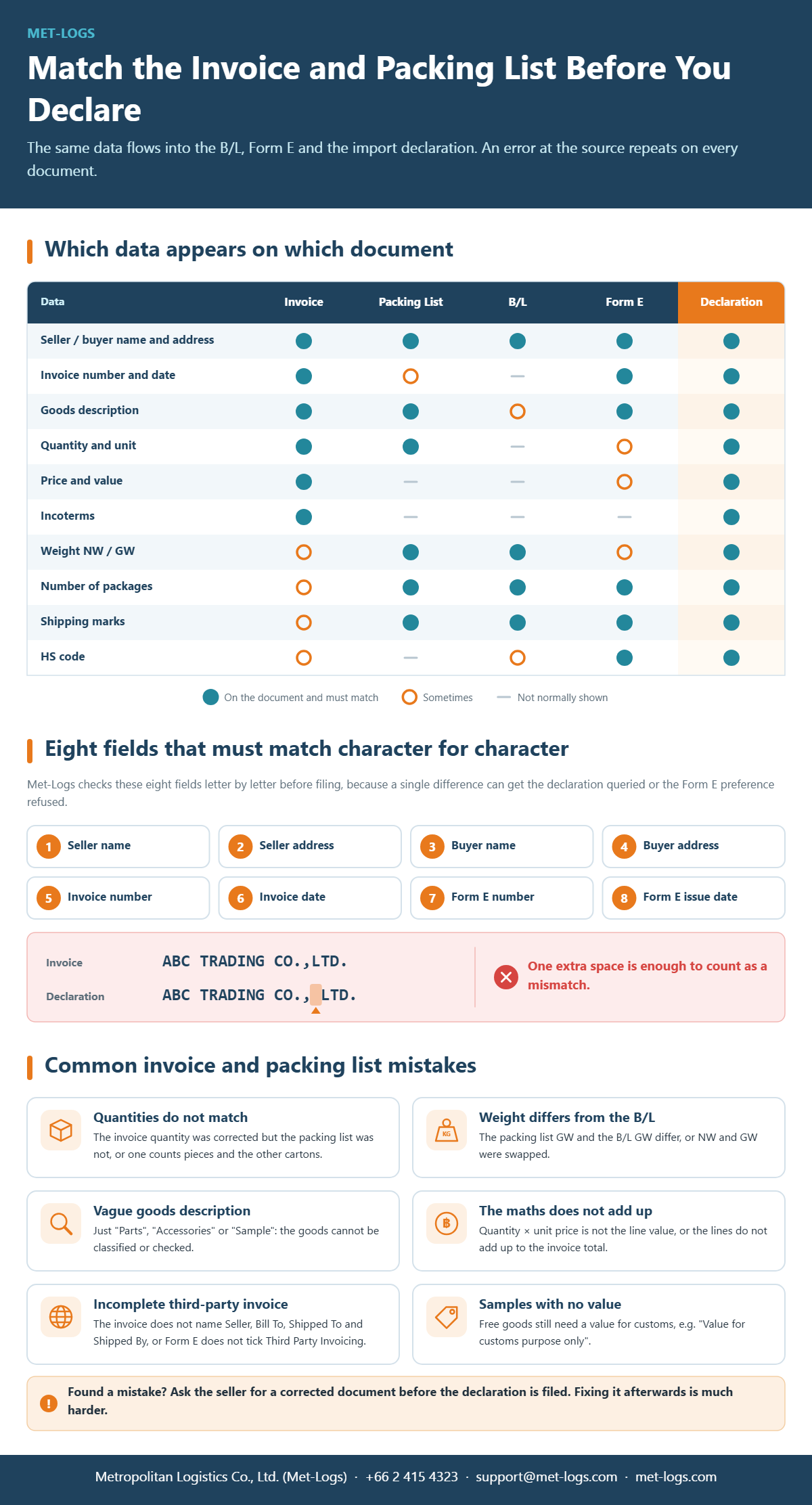
The invoice and packing list are the source of nearly everything on the import declaration. The customs broker keys the declaration from them, then checks it against the bill of lading and, if there is one, the Form E. This table shows where each piece of data appears.
| Data | Invoice | Packing list | B/L | Form E | Declaration |
|---|---|---|---|---|---|
| Seller / buyer name and address | ✔ | ✔ | ✔ | ✔ (boxes 1, 2) | ✔ |
| Invoice number and date | ✔ | Sometimes | – | ✔ (box 10) | ✔ |
| Goods description | ✔ | ✔ | Sometimes (often generic) | ✔ (box 7) | ✔ |
| Quantity and unit | ✔ | ✔ | – | Sometimes (box 9) | ✔ |
| Price and value | ✔ | – | – | Sometimes (FOB in box 9) | ✔ |
| Incoterms | ✔ | – | – | – | ✔ |
| Weight NW / GW | Sometimes | ✔ | ✔ (GW) | Sometimes (box 9) | ✔ |
| Number of packages | Sometimes | ✔ | ✔ | ✔ (box 7) | ✔ |
| Shipping marks | Sometimes | ✔ | ✔ | ✔ (box 6) | ✔ |
| HS code | Sometimes | – | Sometimes | ✔ (6 digits) | ✔ (8 digits + statistical code) |
Common exceptions: on a “to order” B/L the consignee box will not show the buyer’s name, and Form E shows the FOB value in box 9 only when the regional value content (RVC) criterion is used. An HS code on the seller’s invoice is the exporting country’s code; it is a useful hint but should not be copied onto the Thai declaration unchecked (see How to check Thai customs tariff codes).
Eight fields that must match character for character
Before filing an import declaration, the Met-Logs team checks these eight fields letter by letter rather than by meaning. A single difference, such as ABC TRADING CO.,LTD. against ABC TRADING CO., LTD. (one extra space), can be enough to get the declaration queried or the Form E preference refused.
- Seller name
- Seller address
- Buyer name
- Buyer address
- Invoice number
- Invoice date
- Form E number
- Form E issue date
Other fields, such as goods descriptions, weights and quantities, are compared by value and meaning, and every line is checked for quantity × unit price = value. Dates written in different formats, such as 2026-11-05 and 05 NOV 2026, count as the same date.
The invoice and Form E
- Box 10 of Form E carries the number and date of the invoice, which must be the invoice used for the declaration.
- If the invoice is issued by a company in a third country, tick Third Party Invoicing in box 13, give the invoice number in box 10, and show the invoicing company’s name and country in box 7.
- The description in box 7 must be detailed enough for Customs to identify the goods, and the shipping marks in box 6 must match the packing list.
Third-party invoicing: name all four parties on the invoice
When the company that sells and invoices the goods is not the company that actually ships them, the Seller on the invoice will not match the shipper on the B/L or the exporter in box 1 of Form E. That is not an error, but the invoice must then name every party so the documents can be tied together.
| Party on the invoice | Who it is | Must be consistent with |
|---|---|---|
| Seller | The company that sells the goods and issues the invoice (in a third country) | The invoicing company’s name and country in box 7 of Form E |
| Bill To (Sold To) | The buyer being invoiced | The buyer on the import declaration |
| Shipped To (CNEE) | The consignee receiving the goods | The consignee on the B/L and in box 2 of Form E |
| Shipped By (Shipper) | The exporter that actually ships the goods from origin | The shipper on the B/L and the exporter in box 1 of Form E |
Common invoice and packing list mistakes
- Quantities do not match: the invoice quantity was corrected but the packing list was not, or one document counts pieces and the other cartons or sets.
- Weight differs from the B/L: the packing list GW and the B/L GW differ, or NW and GW were swapped.
- Vague descriptions: just “Parts”, “Accessories” or “Sample”, so the goods cannot be classified or checked.
- The maths does not add up: quantity × unit price is not the line value, or the lines do not add up to the invoice total.
- Incomplete third-party invoice: the invoice does not name Seller, Bill To (Sold To), Shipped To (CNEE) and Shipped By (Shipper), or Form E does not tick Third Party Invoicing.
- Samples with no value: free goods and samples still need a value for customs, e.g. “Value for customs purpose only”.
- No Incoterms: nobody can tell whether the invoice price already includes freight and insurance.
What to do when the documents do not match
The easy fix is before the declaration is filed: ask the seller for a corrected invoice or packing list. If the same error is on the B/L, ask the carrier or forwarder that issued it for an amendment; if it is on Form E, the exporter has to go back to the issuing authority. Once the declaration has been filed, corrections go through Thai Customs, and if they change the duty payable they can bring additional duty, surcharges or fines (summarised in our HS code guide). That is why it pays to get copies of the invoice and packing list before the vessel arrives, so the broker has time to check them.
How long must you keep the commercial invoice?
At least five years from the date the import declaration is filed. Section 63 of the Thai Customs Act B.E. 2560 (2017) requires importers, exporters, carriers and other persons named by the Director-General to keep the accounts, documents, evidence and data relating to goods that pass through customs for at least five years from the date of import or export. In practice, count the five years from the date the declaration is filed.
- It is not just the commercial invoice: keep the packing list, B/L, Form E, permits and payment records for the same shipment together.
- If the business closes, the records must be kept for another two years from the closing date.
- How the records are kept (for example as files) follows the rules set by the Director-General of Thai Customs.
These are the documents that back up the declared value and details if Thai Customs audits the shipment after release.
FAQ
What is an invoice and packing list?
They are the two documents that accompany an international shipment. The commercial invoice states what was sold and at what price; the packing list states how the goods are packed, how many packages there are and how much they weigh. Both are used to prepare the customs declaration.
Does a packing list need prices?
No. The packing list covers packages, weights and dimensions; prices belong on the invoice. Figures that appear on both, such as quantity and number of packages, must be identical.
Can a proforma invoice be used for customs clearance?
The declaration should be based on the commercial invoice showing the actual transaction at shipment. A proforma is for the pre-shipment stage: agreeing the price, opening an L/C or paying a deposit. If you only have a proforma, ask the seller for the commercial invoice first.
Who issues the invoice and packing list?
The seller or exporter issues both. Importers should ask for copies by email before the vessel arrives so the customs broker can check them and prepare the declaration in advance.
Do the invoice and packing list have to be submitted to Thai Customs?
Thai import declarations are filed electronically, and the invoice and packing list data are keyed into the declaration. Keep the documents ready to present if Customs asks for them during examination or review.
How many years must a commercial invoice be kept in Thailand?
At least five years from the date the declaration is filed, under section 63 of the Customs Act B.E. 2560, plus two more years if the business closes.
What extra information does a third-party invoice need?
It must name all four parties: Seller, Bill To (Sold To), Shipped To (CNEE) and Shipped By (Shipper). If Form E is used, Third Party Invoicing in box 13 must also be ticked.
Sources
- Thai Customs Department, import procedure (documents to prepare: invoice, packing list, bill of lading, insurance, permits, certificate of origin): customs.go.th (Thai)
- Customs Act B.E. 2560 (2017), section 63 (Royal Gazette vol. 134, part 53 Kor, 17 May 2017): customs.go.th (Thai)
- ASEAN-China FTA, Certificate of Origin Form E and overleaf notes (ACFTA Upgrading Protocol 2019, Appendix 1): fta.miti.gov.my
- Met-Logs: Incoterms 2020, Bill of lading types, Thai HS codes
Working with Met-Logs in Thailand
Met-Logs is a Bangkok-based freight forwarder and customs broker, established in 2009 and a member of the Thai International Freight Forwarders Association (TIFFA). Our in-house customs specialists check the invoice, packing list, B/L and Form E against each other before the declaration is filed, along with the tariff code, duty rate and any licences the goods need. Send us copies of the documents before the vessel arrives. See Customs Clearance and Sea Freight.
Want a second pair of eyes on your documents?
Our team replies within business hours, Monday–Friday 08:30–17:30 (GMT+7).
The company, goods and figures in the example are invented. This article is a summary for general information; an L/C, Form E rules or permit authorities may set further requirements, so check against the actual shipment before declaring.
อ่านฉบับภาษาไทย: Invoice กับ Packing List คืออะไร ต่างกันอย่างไร? ข้อมูลที่ต้องมี ตัวอย่าง และจุดที่ต้องตรงกับใบขนสินค้า